Financial Inclusion 17 min read
What the Next Five Years Could Hold for Digital Finance in Ethiopia

Author

Kaleab Girma
Published on
27 Jan 2026
Undoubtedly, Ethiopia’s first National Digital Payments Strategy from 2021 to 2024 laid the foundation for the nation’s digital financial ecosystem. The then forward-looking document served as a blueprint, and the strategy successfully targeted critical barriers from the establishment of critical infrastructure to regulatory reforms that have welcomed new players.
Between 2020 and 2025, mobile money accounts exploded from 12.2 million to 139.5 million. Mobile banking accounts surged from 9.1 million to 54 million in the same period. Annual transaction values grew at a compound annual growth rate of 161%, respectively, reaching 18.5 trillion Birr at the end of 2025.
Yet despite visible progress, a persistent question remains unresolved: has digital finance truly entered everyday economic life for most Ethiopians, or are we still celebrating numbers rather than impact?
Account ownership has grown faster than account usage. Millions of Ethiopians now hold transactional accounts, but only a fraction use them regularly. The 30-day active rate for mobile money accounts stands at just 15%, meaning 85% of the 139.5 million accounts sit essentially dormant.
Person-to-person transfers dominate transaction volumes, while merchant payments remain rare. Digital payments are more visible in urban centers, but adoption remains uneven in rural areas. Gender gaps persist, shaped by unequal access to devices, lower digital literacy, and social norms. Trust remains fragile. A single social media post from a user rightfully complaining about failed transactions sparks dozens of similar stories from others. This trust is also eroded by fraud incidents, opaque pricing, and weak consumer recourse mechanisms.
For many users, digital finance is perceived as useful but not yet entirely dependable. These patterns are not unique to Ethiopia. They reflect a common trajectory seen across many emerging digital finance markets. What distinguishes the current moment is the growing clarity around what needs to change.
This is the central challenge that Ethiopia's recently launched National Digital Payments Strategy (2026-2030) (NDPS II) seeks to address. With this roadmap, the country enters a new phase of its digital finance journey, one that places less emphasis on access alone and far greater weight on usage, trust, and inclusion. This shift reflects both lessons learned from the past and a growing recognition that infrastructure, while necessary, is not sufficient on its own.
The 128-page document was developed through extensive consultation with public and private sector stakeholders. It lays out an ambitious roadmap organized around six pillars, collectively forming what the National Bank of Ethiopia calls the "BRIDGE 2030" framework.
It sets measurable targets that, if achieved, would transform Ethiopia's digital payments landscape from one of potential to one of genuine inclusion. But the document also reveals the profound challenges that stand between aspiration and reality.
Digital Payment Adoption Through Merchants and Public Services
Creating strong, everyday use cases for digital transactions is a central pillar of the strategy, with particular focus on addressing the merchant acceptance bottleneck.
A Merchant Acceptance Development Fund is poised to subsidize the deployment of low-cost acceptance solutions, particularly QR codes and mobile POS devices, in underserved areas, targeting the onboarding of at least 20,000 micro-merchants. To reduce onboarding friction, the strategy proposes Personal Retail Accounts (PRAs): simplified, risk-based accounts with streamlined KYC requirements that allow informal micro-merchants to begin accepting digital payments via QR codes without the documentation burden of standard business accounts.
Beyond merchant acceptance, the strategy identifies high-frequency payment flows as catalytic opportunities. Full digitization of government-operated transport services targets 60% of fares collected digitally by 2030, transforming a daily necessity into a habitual digital payment use case for millions. Integration of digital payments into agricultural input distribution, particularly fertilizer procurement, will bring farmers into the formal financial system while reducing leakages in subsidy distribution, with a target of 50% of agricultural inputs paid digitally. The public healthcare ecosystem is set to be comprehensively digitized, from facility payments and pharmacy supply chains to health insurance premiums and healthcare worker salaries, also targeting 50% digitization.
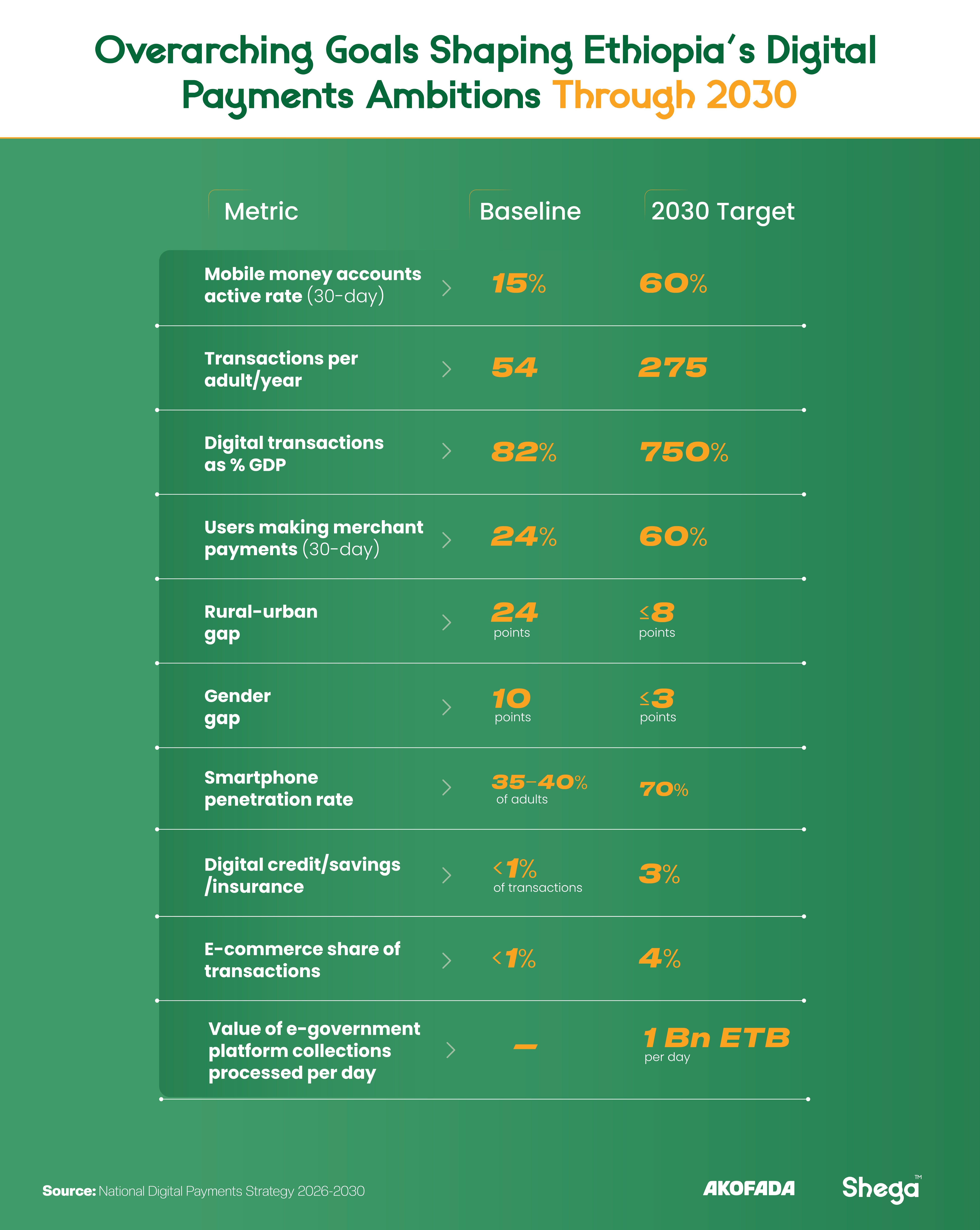
For end-users, two interventions tackle fundamental access barriers. A handset subsidy and local assembly incentive program aims to drive smartphone penetration from 35-40% to 70% of adults. A planned agreement with mobile network operators to zero-rate USSD fees for digital transactions aims to eliminate the indirect cost that could deter low-income users from transacting via the most accessible channel.
Shared Platforms for Government Payments and Data
The policy paper adopts a clear Digital Public Infrastructure approach. Payments are positioned as one layer in a broader system that includes national digital ID, data exchange frameworks, and shared platforms.
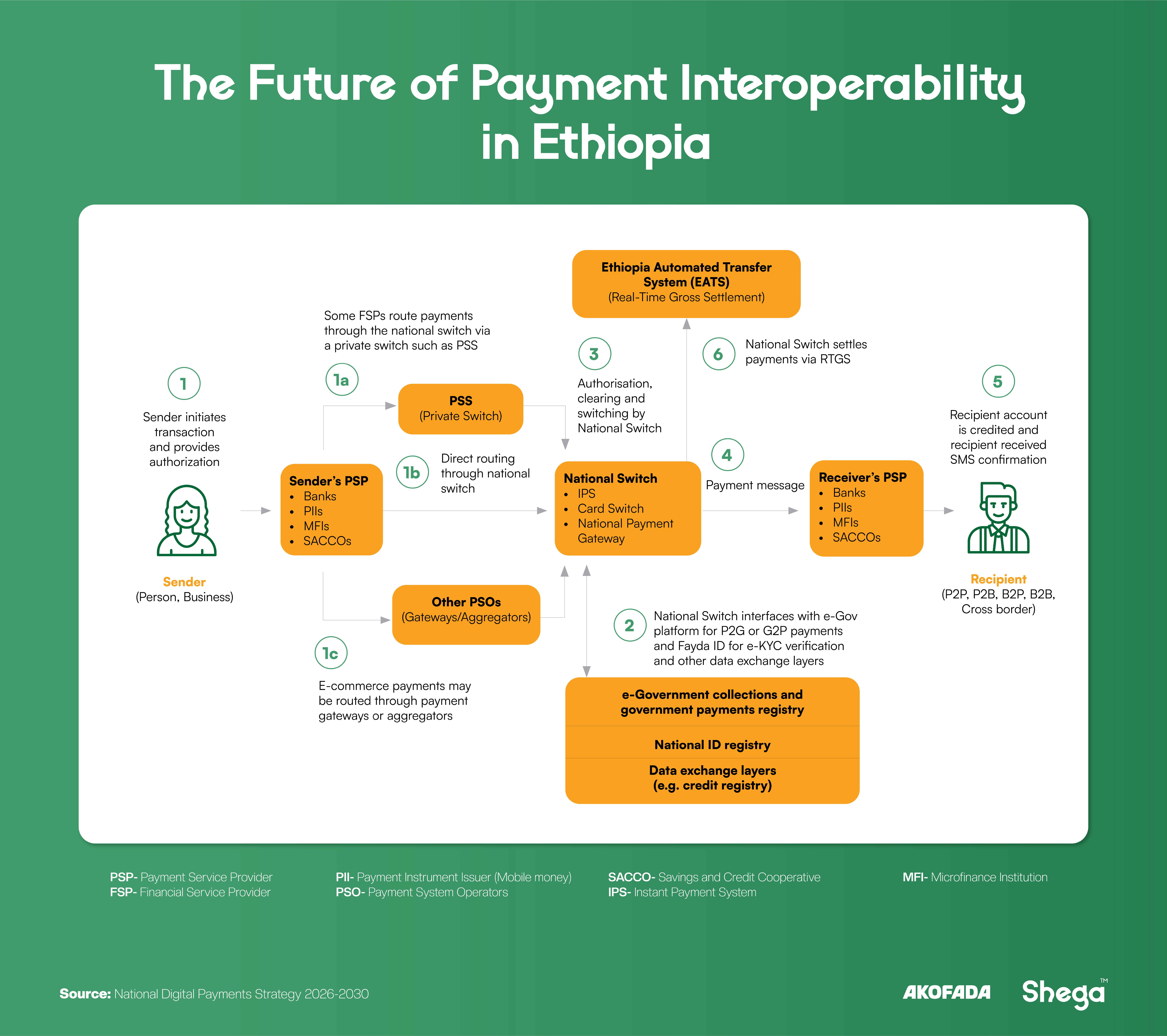
Three major initiatives anchor this pillar. First, a unified e-government service platform is expected to consolidate all person-to-government payments, from licenses and taxes to fuel and utilities, into a single interoperable system, replacing the current fragmented landscape of bilateral agreements between specific ministries and financial service providers. The goal is to process 1 billion Birr in daily government collections by 2030.
Second, a shared government-to-person (G2P) disbursement hub is expected to centralize all social transfer programs onto a single API-enabled platform connected directly to the Ethiopia Instant Payment System (EIPS). This should enable real-time disbursements while crucially allowing beneficiaries to choose which financial service provider receives their funds, breaking the current lock-in where recipients must open accounts with specific banks. The target: 80% of all G2P payments processed digitally via the hub by 2030.
Third, the strategy mandates the development of a formal data exchange framework with consent management protocols, laying the groundwork for what could eventually evolve into an open finance ecosystem. While full open finance may be an objective for the next strategy cycle, this foundational step may establish the technical infrastructure and regulatory certainty needed to begin unlocking siloed financial data for innovation. A centralized data exchange infrastructure is expected to be operational by 2030.
Closing the Digital Finance Knowledge Gap
No amount of infrastructure investment can overcome a knowledge gap as severe as Ethiopia's, where 66% of women and 60% of men do not use mobile money because they do not know how.
A collaborative cost-sharing mechanism led by the Ethiopian Bankers Association is expected to pool resources from across the financial services sector to fund coordinated, multilingual digital and financial literacy campaigns tailored by product type and user segment. The target: five national campaigns annually, raising awareness among 80% of adults (from 20% currently) and reducing the percentage citing literacy as a barrier to below 10% for both men and women.
Crucially, the framework leverages existing trust networks rather than relying solely on mass media. Agent networks and leaders of traditional community-based finance groups such as Equb and Edir chairpersons will be trained to serve as community influencers, providing practical guidance on digital payment usage and safety. This peer-to-peer model can meet users where they are, within contexts they already trust.
New Consumer Protection Rules
On consumer protection, the strategy proposes an Authorized Push Payment (APP) fraud directive that would mandate reimbursement when the financial institution's staff, agents, or systems are at fault. Critically, this could implement liability-sharing between sending and receiving institutions, creating powerful incentives for both to invest in prevention.
The document also mandates clear, upfront disclosure of all transaction pricing before confirmation, addressing the widespread perception that digital payments have hidden costs. A proposal for a Consumer P2P Transaction Fee Reform Initiative aims to audit current pricing structures and introduce more consumer-friendly models, particularly for low-value transfers.
The fraud target is to reduce the rate from 0.0153%, which is significant when one takes into consideration that this data is currently underreported, to 0.0008% of transaction value by 2030, with 100% of providers complying with standardized reporting protocols. To complement the initiative, sustained industry-funded national awareness campaigns focused specifically on social engineering fraud are proposed in the strategy.
Competition and Fair Access Measures
Perhaps most significantly, the strategy commits to developing clear directives for digital lending (including peer-to-peer), digital savings, and digital insurance products, areas where regulatory ambiguity has impacted users. A framework is set to be established to enable private-sector credit reference bureaus to support digital lending, while the public credit reference bureau at the NBE will be expanded to incorporate alternative data sources and develop credit scoring models appropriate for the uncollateralized, high-frequency nature of digital loans.
Competition concerns that many have pointed to are stated explicitly as an ecosystem challenge. The strategy notes “A small number of large providers hold a disproportionate share of the market, particularly in key segments like government payments, creating competitive imbalances… this combination of market concentration and potential for unfair access to infrastructure can stifle competition, limit consumer choice, and slow the pace of innovation.”
To foster competition, the guiding document calls for a financial sector-specific competition policy and a Fair Access Directive mandating that mobile network operators provide all licensed financial service providers with open, non-discriminatory access to essential infrastructure like USSD channels, apps, and APIs on transparent terms.
The strategy even signals openness to capital market integration and virtual assets, with a framework to enable bank-stockbroker partnerships (allowing retail investors to access equities via digital banking or wallet apps) and a comprehensive study of stablecoins, cryptocurrencies, and central bank digital currency, with white papers to articulate Ethiopia's policy stance.
The target: digital credit, savings, and insurance products accounting for 3% of total digital transaction value by 2030 (up from less than 1% today), and e-commerce transactions reaching 4% of digital payment volumes
The Governance and Execution Challenge
Ambitious strategies often fail not in design but in implementation. Recognizing this, the NDPS II establishes a streamlined governance structure, which it says has shorter reporting lines than the previous strategy.
A new National Payment System Council, chaired by the NBE Governor and including representatives from key implementing ministries and industry associations (Bankers Association, Microfinance Association), is set to provide executive-level mandate and support. The NBE's Payment and Settlement Systems Directorate serves as the Secretariat, managing overall implementation, coordinating across the 81 specific actions, and administering the monitoring and evaluation framework.
Each of the six pillars has a designated leader: EthSwitch for infrastructure, the NBE Financial Inclusion Secretariat for inclusion, and so forth. These institutions coordinate the actions within their domain and report progress to the Secretariat. Individual Action Leaders are responsible for executing specific interventions, liaising with ecosystem collaborators, and escalating bottlenecks.
The monitoring, evaluation, and learning (MEL) framework is notably robust. A publicly accessible quarterly progress tracker is planned, which will be maintained via a Google Sheets dashboard, providing transparency on implementation status using a traffic-light system. Annual progress reports will consolidate quantitative tracking with qualitative insights and lessons learned. A midline evaluation in 2028 will enable mid-course corrections, with a final independent evaluation in 2030 measuring overall impact against the strategy's 11 overarching goals.
But transparency doesn't eliminate risk. The implementation plan reveals significant challenges. Timelines are aggressive: 16 "quick win" actions expected within 6 months, numerous high-priority initiatives within 12-24 months, and long-term projects spanning 48 months. Coordination complexity is substantial, involving 15+ implementing institutions across public and private sectors. Capacity constraints are real, and this strategy layers on dozens of simultaneous workstreams. Funding sources for major initiatives like the Merchant Acceptance Development Fund, shared infrastructure platforms, and innovation labs remain to be determined.
The risk matrix in the policy playbook acknowledges these challenges. Political and regulatory delays in approving necessary directives and proclamations are flagged as high risk. Stakeholder coordination, particularly given competing commercial interests on shared infrastructure, is another high-risk area. The proposed mitigation measures rely heavily on high-level buy-in through the Council structure, phased implementation to manage workload, and public-private partnerships to distribute costs.
The question is whether Ethiopia can avoid what the strategy itself implicitly acknowledges: "strategy shelf syndrome," where ambitious documents gather dust while implementation stalls.
The 2030 Litmus Test
For an ecosystem that has spent years identifying gaps and building evidence, the coming phase is no longer about asking what is broken. The answers are already clear. Expecting government officials to publicly catalogue the failures of the previous phase is unrealistic. Instead, the data speaks for itself, and the new strategy is, in many ways, an implicit acknowledgement of those shortcomings.
The strategy for the next five years makes bold bets: that shared infrastructure can overcome competitive instincts, that regulation can keep pace with innovation, that literacy can be built at scale, that trust can be restored amid rising fraud, and that 100 million dormant accounts can be activated through better design and compelling use cases.
The verdict won't be subtle, and Strategy's authors have chosen accountability. By 2030, either 60% of accounts will be active (up from 16%) or they won't. Either 275 transactions per adult will flow annually, or they won't. Either digital transaction value will reach 750% of GDP (up from 82%) or it won't.
What distinguishes this strategy from its predecessor is not just the shift from infrastructure to usage but the recognition that usage is multidimensional. Ethiopia has built the rails. The next five years will show whether the country can make people want to ride them and whether policy ambition can translate into market reality.
The real test ahead lies in how Ethiopia’s digital payments infrastructure is used. Its impact will be measured by whether it reaches all Ethiopians, creates space for innovation, and translates into genuine financial inclusion rather than symbolic progress.
Author
Kaleab Girma
Kaleab Girma, an Addis Ababa-based reporter and researcher, with over six years of experience in the field. He currently serves as Shega's Editor-in-Chief and specializes in reporting on small businesses, innovation, technology, and startups in Ethiopia.
Most Read Articles
Discover what others are reading
Latest News
Announcements and coverage you might have missed



Latest Pieces
Perspectives curated from partners and peers
